

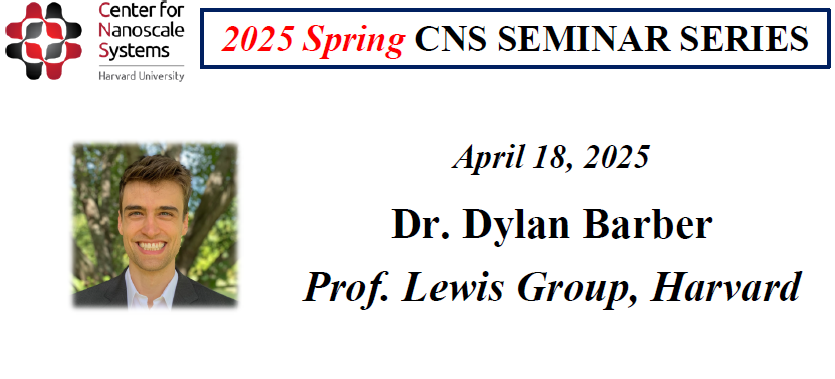
CNS Seminar: Dr Dylan Barber – Rational Design of Polarizable Soft Matter
September 23, 2026
LISE 303 12pm-1pm, April 18th 2025
Abstract: Polarizable soft matter has broad potential impact, from electrochemical energy storage to soft
robotics and medicine. Yet, the current soft materials palette is restricted to polymers with low permittivity (er = 2-10). Zwitterions, with extraordinary dipole moments up to and exceeding 50 Debye, have been acknowledged as a candidate for polarizable soft materials for twenty years. However, the high melting points Tm > 200 °C of most zwitterions precludes both mechanical compliance and polarizability, limiting their value as polarizable soft matter. Here, we describe the rational design and synthesis of oligomeric zwitterions with elongated, flexible spacers that are stable liquids at room temperature. Under ambient conditions, they exhibit static dielectric constants er as high as 420, the largest reported in any all-organic or soft material, and dramatically lower viscosity (~ 500x) compared to previously reported supercooled zwitterions. Remarkably, the spacer-length-dependent scaling of both dielectric and mechanical properties moderates as the spacer exceeds 1 Kuhn length, suggesting coupling between oligomer structure and behavior in an electric field. When incorporated as pendent groups on a flexible polymer backbone, they afford polymer melts that can be crosslinked to form soft dielectric elastomers, the first example, to our knowledge, of polyzwitterion melts and elastomers, and the foundation for a potentially
new class of polarizable soft matter.
About the speaker: Dr. Barber is passionate about solving problems with better materials. He pursued
this passion as an undergraduate at Williams College by earning a B.A. with honors in Chemistry, during which he synthesized antioxidant block copolymers for drug encapsulation and targeted delivery. Then, he earned a Ph.D. in Polymer Science and Engineering from the University of Massachusetts Amherst under the joint mentorship of Professors Todd Emrick and Alfred J. Crosby. During his Ph.D., fully funded by the NDSEG Fellowship, he developed methods to control the structure and assembly of mesoscale polymer filaments, mimicking the hierarchical assembly of natural materials like collagen and muscle. He is currently a postdoctoral Fellow working with Professor Jennifer A. Lewis at Harvard University, where he 3D-prints conductive lattice electrodes for electrochemical flow systems and develops soft materials with high permittivity.