

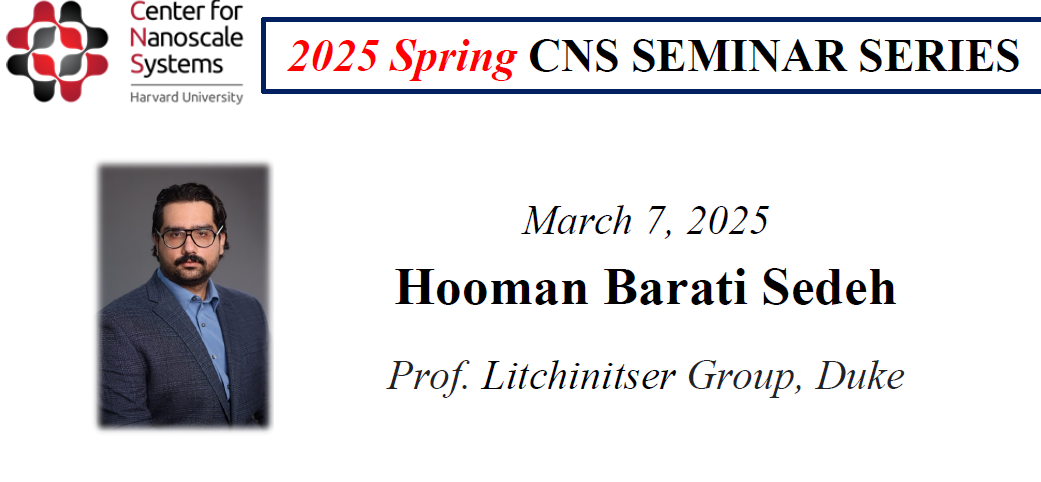
Hooman Barati Sedeh – From Local to Nonlocal Light-Matter Interactions with Nonlinear Metasurfaces
September 30, 2026
LISE 303 12pm-1pm March 27th 2025
Abstract: Deriving their name from the Greek word meta, meaning ‘beyond,’ optical metasurfaces, which are engineered surfaces composed of subwavelength scatterers, have redefined the control of optical fields in space and time, enabling unprecedented manipulation of amplitude, phase, and polarization over the past decade. Initially, metasurfaces were studied under the locality assumption, where the scattering response at a given point was assumed to be independent of neighboring fields or interactions, allowing broadband and angle-insensitive operation. However, breaking this assumption has led to nonlocal etasurfaces, where scattering is influenced by distant fields, extending interactions across multiple scatterers and resulting in narrowband, high Q-factor resonances with strong spectral and angular selectivity. While both local and nonlocal metasurfaces have advanced in the linear optical regime, significant efforts have explored their nonlinear properties, leading to developments in harmonic generation, wavefront manipulation, and entangled photon generation, to name a few. In particular, it has been shown that local nonlinear metasurfaces can enable wavefront generation but suffer from low nonlinear conversion efficiency, whereas nonlocal metasurfaces, despite high-Q-factor modes enabling efficient nonlinear interactions, are limited in simultaneously generating and shaping nonlinear harmonics.
Here, we introduce two complementary approaches to the field of nonlinear meta-optics: one based on local interactions and the other leveraging nonlocal resonances. We present nonlinear topology imprinting, which utilizes local nonlinear metasurfaces to replicate complex wavefronts at fundamental and harmonic frequencies, enabling complex structured light generation while mitigating material
absorption. We also introduce an ultrathin dual-gradient silicon nonlocal metasurface supporting quasi-trapped resonant modes, significantly enhancing nonlinear conversion efficiency over a broad spectral range. By engineering spectral and spatial gradients, we achieve tunable nonlocal resonant modes while simultaneously controlling the wavefront of the generated harmonics through the
Pancharatnam-Berry phase.
About the speaker: Hooman Barati Sedeh received a B.Sc. degree in electrical engineering–communications from Iran University of Science and Technology, Tehran, Iran, in 2019 and his master’s degree in electrical engineering–electromagnetics at Northeastern University, Boston, MA, USA, in 2021. Hooman Barati Sedeh is currently a third-year Ph.D. Candidate, supervised by Professor Litchinitser in the Department of Electrical Engineering at Duke University. His research interest focuses on the theoretical and experimental studies of light-matter interaction with subwavelength meta-atoms for various applications, including nonlinear optics, chiroptical responses, and scattering manipulation.