
CNS Seminar: Microgel-Assisted Isolation of Urinary Biomarkers: Advancing Non-Invasive Prognosis for Bladder Cancer
September 22, 2026
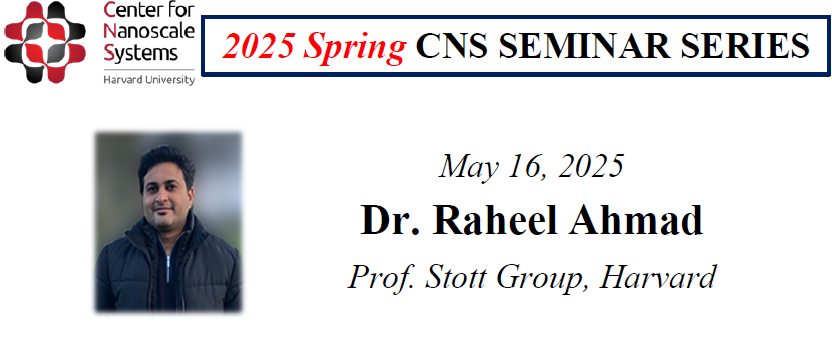
Dr. Raheel Ahmad, Postdoctoral Fellow at Massachusetts General Hospital and Harvard Medical School
12pm-1pm May 16th 2025, LISE 303
Abstract: Extracellular vesicles (EVs) are increasingly recognized for their potential as minimally invasive biomarkers in cancer diagnosis, prognostics, and therapeutic monitoring. Nevertheless, the clinical translation of EV-based prognostic is constrained by formidable challenges associated with their isolation from complex biological matrices such as urine. These include yield, specificity, and preserving EV structural integrity and functional molecular cargo. In this talk, I will introduce a microgel bead-based method for the efficient isolation of EVs from biofluids. The platform is meticulously designed utilizing chitosan and poly-L-lysine, exploiting their surface charge to facilitate rapid, high-yield recovery of vesicles. The adjustable pH-dependent surface charge of the microgel beads enables highly efficient and label-free capture of EVs through the inherent negative surface charge of the phospholipid bilayer membrane. To demonstrate feasibility, EVs were isolated from prostate cancer cell line and clinically annotated bladder cancer urine samples using a microgel bead platform, yielding 1.3- and 1.7-fold higher EV isolation efficiency, respectively, compared to gold standard techniques, while enabling enhanced molecular profiling. Validation of bladder cancer-specific transcripts in urinary EV RNA underscores the potential for a non-invasive prognostic tool. Overall, microgel bead technology holds significant potential for advancing urinary biomarker-based prognostics.
About the speaker: Raheel Ahmad is a Postdoctoral Fellow in Shannon Stott’s group at Massachusetts General Hospital and Harvard Medical School, where he explores how cancer-derived extracellular vesicles can be leveraged to build non-invasive prognostic tools. Prior to joining the Stott Lab, Raheel completed his PhD at the Max Planck Institute in Göttingen, Germany, where he was awarded a Marie Curie Fellowship. During his doctoral research, he engineered cell-like systems to study microtubule dynamics under ATP-driven forces and developed bio-hybrid micro-swimmers with potential applications in targeted drug delivery. He is an active member of the International Society for Extracellular Vesicles and serves on the reviewer board of the Journal of Extracellular Vesicles.